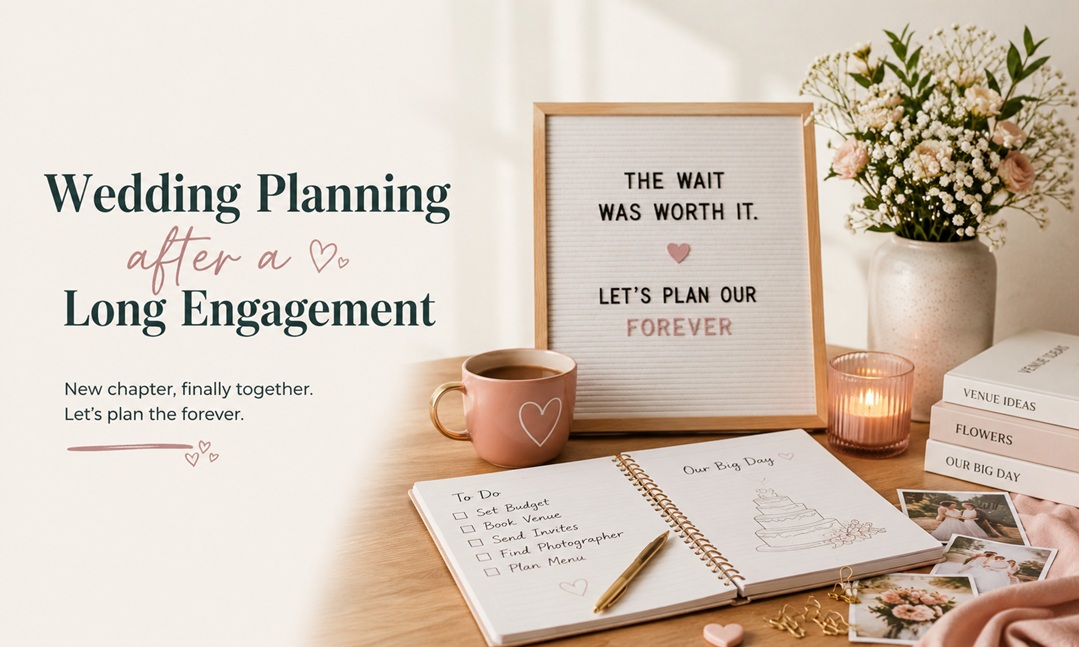
The fastest way to start wedding planning after a long engagement is to set a real date within the next two weeks, then work backward from it with a simplified six-to-twelve month timeline focused on the handful of decisions that actually need to happen early — venue, guest list, and budget. Long engagements often stall not from lack of love, but from too many open-ended decisions with no deadline forcing a choice.
The Problem: Decision Fatigue After Years of “Someday”
A long engagement has its own kind of trap. Early on, there’s no rush, so big decisions get postponed indefinitely. A few years in, the absence of momentum starts to feel normal, and starting suddenly feels harder than it should — partly because there’s an unspoken pressure that everything now has to be perfect, since you’ve “had so much time to plan.”
The honest fix is recognizing that more time hasn’t actually made planning easier. It’s mostly just delayed the moment you have to start making real decisions. The earlier you accept that, the sooner the actual planning can begin.
The Solution: A Simplified Timeline That Cuts Through the Noise
Set the date first, even before the venue is locked in. A target date — not a vague season, an actual date or narrow window — gives every other decision a deadline, which is the single biggest unlock for couples who’ve been stuck.
From there, a simplified order of operations:
Months 9–12 before the date: Finalize guest list size (this drives almost every other decision, including venue and budget), set the overall budget, and book the venue and officiant.
Months 6–9 before: Book major vendors — photographer, caterer, florist — since the best ones in any area get booked out months in advance.
Months 3–6 before: Send invitations, finalize the menu, handle attire fittings, and confirm details with vendors.
Final 1–2 months: Confirm final headcounts, create the day-of timeline, and handle the small details — seating chart, favors, final payments.
Couples who’ve been engaged a long time often have a head start on some of this without realizing it — a venue style they’ve already discussed, a rough guest list they’ve mentally settled on. Use that existing groundwork instead of starting from a blank page.
Local Insights: Booking Windows and Seasonal Pricing
In much of the U.S., popular venues and top-tier vendors in peak wedding months (typically late spring through early fall) get booked out nine to twelve months in advance, sometimes longer in major metro areas. If your long engagement means you’re now planning on a shorter timeline than that, an off-peak date — late fall, winter, or a weekday — often opens up significantly more venue and vendor availability, frequently at a lower price too.
Regional pricing varies a lot. A wedding budget that goes far in a smaller city or rural area may need real adjustment for a major metro market, where venue and catering costs can run noticeably higher for comparable quality.
Frequently Asked Questions
*Is our engagement “too long”?*
There’s no meaningful cutoff. What matters more is whether the engagement length reflects an active choice (saving money, waiting for a life milestone) versus simply momentum loss. If it’s the latter, setting a date is usually the real fix, not waiting longer for the “right” moment to appear on its own.
*Do we need to update our guest list after this much time?*
Almost certainly, yes. Friendships shift, family situations change, and a guest list drafted years ago rarely matches who you’d actually invite today. Treat the guest list as a fresh decision, not an inherited one from your original engagement.
*Has our budget changed?*
Likely, in both directions — either you’ve saved more than expected, or costs in your area have shifted since you first got engaged. It’s worth re-pricing venues and vendors with current numbers rather than assuming estimates from a few years ago still hold.
A long engagement isn’t a problem to apologize for. It just means the planning phase needs a clear starting trigger — a real date on the calendar — to turn “someday” into a wedding that actually happens.
A Small Tip for Getting Unstuck
If setting a date still feels overwhelming after years of putting it off, try picking three possible date ranges instead of one perfect date, then call your top venue choice and ask which of those windows they have open. Letting venue availability narrow the choice for you removes a surprising amount of pressure, and it turns an abstract decision into a concrete one within a single phone call.