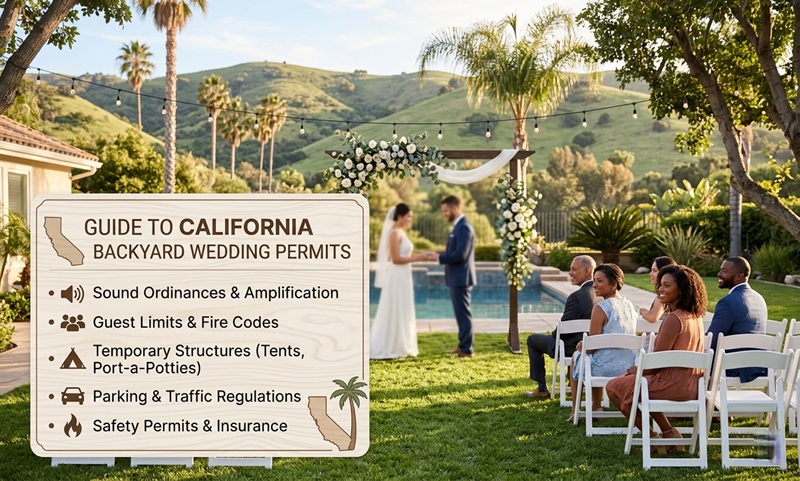
A backyard wedding sounds simple — your home, your rules, your big day. But in California, “simple” events on private property can still trigger a handful of local permit requirements depending on your county, guest count, and what you’re planning. Skipping this step can mean fines, early shutdowns, or issues with your caterer’s license.
Here’s a practical breakdown of what backyard wedding permit requirements in California actually look like, so you can plan ahead instead of scrambling last minute.
Do You Need a Permit for a Backyard Wedding in California?
The honest answer: it depends on your county and city.
California doesn’t have a single statewide permit system for private events. What matters is:
- Your municipality (city vs. unincorporated county land)
- Your guest count
- Whether you’re serving alcohol
- Whether you’re using amplified sound
- Whether you’re bringing in tents, generators, or portable restrooms
A small backyard ceremony of 30 people with no hired vendors might need nothing. A 150-person reception with a live band, portable bar, and event tent almost certainly will.
Key Permit Categories for Backyard Weddings in California
1. Temporary Use / Special Event Permit
Most California cities and counties require a Temporary Use Permit (TUP) for private events that exceed a certain size — often 50 or 75 guests. You apply through your city’s planning or zoning department.
Cost: typically $50–$300 depending on jurisdiction.
Timeline: Apply at least 4–6 weeks in advance.
2. Noise / Sound Permit
If you plan live music, a DJ, or amplified sound after 10 p.m. (or sometimes 8 p.m. in residential zones), a noise variance permit may be required. Los Angeles and San Francisco have strict noise ordinances for residential areas.
Even if a permit isn’t required, notifying your neighbors in writing — and getting their informal sign-off — is good practice.
3. Alcohol Permit (ABC License)
Hiring a bar service that charges guests for drinks? Your caterer or bartender needs a California ABC license. If you’re providing free alcohol to guests as part of the event (no cash bar), you generally don’t need a separate license — but the catering company serving it often still does.
Check with the California Department of Alcoholic Beverage Control at abc.ca.gov for specifics.
4. Health Permit for Catering
Any third-party caterer operating in California must have a valid county health permit. Ask your caterer for their permit number before signing a contract. In Los Angeles County, the Environmental Health division handles these.
5. Tent and Structure Permits
Renting a large tent (typically over 400 sq. ft.) may require a temporary structure permit from your local building department. This is especially common in fire-prone areas under CalFire jurisdiction.
County-by-County Quick Reference
| County | TUP Required? | Noise Curfew | Notes |
|---|---|---|---|
| Los Angeles | Often (75+ guests) | 10 p.m. residential | Strict enforcement in HOA areas |
| San Diego | Often (50+ guests) | 10 p.m. | Check city vs. county rules |
| Orange County | Varies by city | 10 p.m. | Laguna Beach very strict |
| San Francisco | Yes (most events) | 10 p.m. | Dense residential, high scrutiny |
| Sacramento | Often (75+ guests) | 11 p.m. | More flexible outside city core |
Pro Tips for Smooth Permit Navigation
- Start with your city’s planning department website. Search “[Your City] special event permit” — most have online applications now.
- Hire a local wedding planner. Experienced California wedding planners know your county’s exact requirements and often have vendor relationships that streamline approvals.
- Check your HOA rules. Even before permits, many California neighborhoods have HOA bylaws that restrict events over a certain size or duration.
Common Mistakes to Avoid
- Assuming you don’t need anything because it’s your own property. Private property doesn’t exempt you from municipal noise or occupancy rules.
- Forgetting to tell your caterer about the permit process. They may need to be listed on the permit.
- Applying too late. Some jurisdictions have 30–60 day processing windows. Last-minute applications often get denied or delayed.
FAQs
Q: Do I need a permit for a small backyard wedding in California?
For gatherings under 50 people with no hired bar service and no amplified music after 10 p.m., many California cities don’t require formal permits. But always verify with your local city or county.
Q: How much does a backyard wedding permit cost in California?
Temporary use permits typically run $50–$300. Noise variances, ABC involvement, and structural permits can add more. Budget $200–$800 total for permit costs in most cases.
Q: Who do I contact for a California backyard wedding permit?
Start with your city’s Planning Department or Community Development Department. For alcohol, contact the California ABC. For food service, contact your county’s Environmental Health office.
Q: Can I get fined for hosting a backyard wedding without permits?
Yes. Fines vary by city but can range from $100 to $1,000+ per violation, and events can be shut down by local code enforcement.
Conclusion
A backyard wedding in California can be a beautiful and personal choice — just make sure the paperwork doesn’t catch you off guard. Start by contacting your city’s planning office six to eight weeks out, get your caterer’s credentials in order, and check your HOA rules before you book anything. A little upfront research saves a lot of last-minute stress — and lets you actually enjoy the day.